


W. Britain
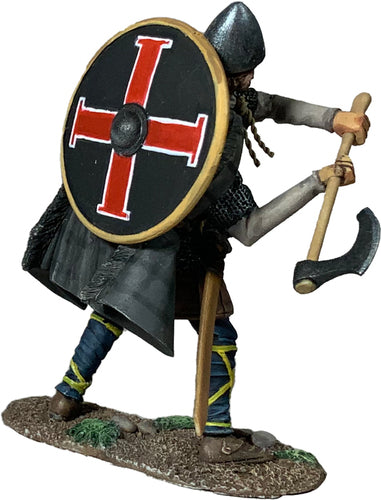
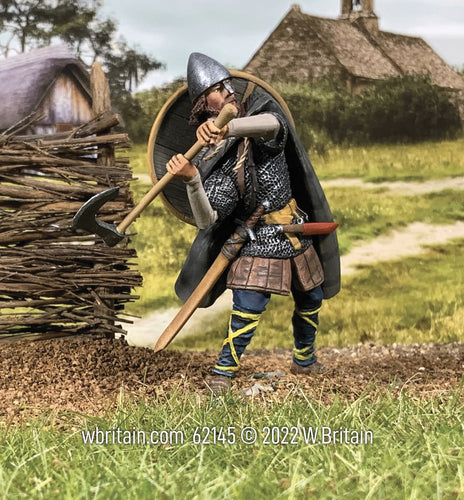
"Abrecan" Saxon Attacking with Axe
"Abrecan" Saxon Attacking with Axe
Couldn't load pickup availability
The least conspicuous object on this figure is the knife lying across the front of his belt, and it may be the thing an entire people was named after. Seax is simply the Old English word for knife, from a Common Germanic root *sah, *sag-, "to cut" — and, as the standard account puts it, "the name of the Saxons has traditionally been said to derive from a kind of knife used in this period and called a seax in Old English and sahs in Old High German." Traditionally is doing real work in that sentence: the derivation is old, widely repeated, and still hedged by careful writers rather than proved. The word "scramasax", often attached to these blades, deserves the same caution — it is not attested in Old English at all, but taken from a single occurrence of scramasaxi in Gregory of Tours. The objects, though, are beyond argument. They run from small belt knives up to the langseax, with blades of 50 cm or more, and they were carried precisely as this one is: worn horizontally in a scabbard on the belt, edge upwards. The finest survivor came out of the Thames near Battersea in 1857 — a tenth-century blade 72.1 cm long overall, its grooves inlaid with hammered strips of twisted copper, brass and silver wire, bearing on one face the only known complete inscription of the twenty-eight letter Anglo-Saxon runic alphabet and on the other a single name, Beagnoth, "Ringbold". Whether Beagnoth forged it, cut the runes, owned it or gave it away, nobody can say; it is one of only a handful of blades ever found with runes on them. A tool a farmer could afford, a weapon kept where the hand falls, and once in a while an object grand enough to carry a whole alphabet. Three seaxes still sit on the arms of Essex.
Abrecan — the name means "storm" — comes forward with a long-hafted bearded axe in both hands, his round shield slung out of the way on his back, mail to the thigh under a heavy grey cloak, and a one-piece iron helmet with a nasal bar. Why that axe head is shaped the way it is, and what the beard was actually for, is the subject of his opposite number "Torgny" Viking Attacking with Axe. The contrast worth noticing is with "Broga" Saxon Attacking with Sword: a pattern-welded sword was the work of a specialist and the price of a small farm, while a seax was within the reach of an ordinary blacksmith — which is why so many men carried one and so few carried the other. Set him alongside "Grindan" Saxon Attacking with Axe for a pair of axemen going in together, with "Bestanden" Saxon Defending with Sword and Shield holding the line behind them — a small diorama of an English counter-attack, the shields going back and the axes coming up.
Model: 62145 / W. Britain / 1/30 scale / matte finish / 1 piece set
Share
Materials
Materials
Metal
Dimensions
Dimensions
54mm
Care information
Care information
These are not play toys. They are collectables. Recommended for 14 yrs old and older.


Continue Shopping
See more of the Breagans' collection of manufacturers from all around the world
Subscribe to our emails
Subscribe to our mailing list for insider news, product launches, and more.