


W. Britain
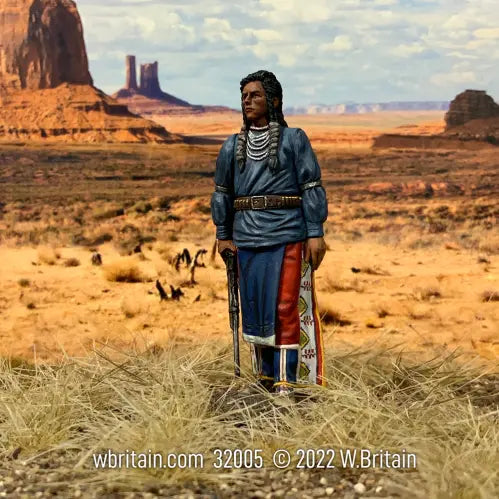
Curly, 7th Cavalry Scout (32005)
Curly, 7th Cavalry Scout (32005)
Couldn't load pickup availability
Ashishishe — Curly — was an Apsáalooke scout, born around 1856, who rode with Custer's column and was sent away with three other Crow scouts before the heavy fighting began. He watched from a distance and "did not actively participate in the battle." He then reached the steamer Far West and reported what he had seen "using a combination of sign language, drawings, and an interpreter," because he spoke almost no English. Everything the world knows him to have said passed through somebody else first, and that is the whole story of his life afterwards. Thomas Leforge, the white interpreter who handled one of the earliest interviews, recorded him saying "I did nothing wonderful; I was not in it," and was blunt about what followed: "he was spoken of then as the 'sole survivor' of the disaster," but "he himself did not lay claim to that kind of distinction" — it was "the persistent claim put forward for him by others, but as though it came direct from him." Meanwhile "romantic writers seized upon Curly as a subject suited to their fanciful literary purposes," and the versions multiplied: that he had escaped disguised as a Lakota warrior, that he had cut up a blanket, that he had hidden inside a gutted horse. Asked about all of it by the Custer historian Walter Camp, Curly is said to have given the only answer that covers the facts: "I have always told the same story, but there have been different interpreters." There is a postscript that makes the point better than any argument. From about 1908 a white confidence man named Ben McIntosh toured the West billing himself as the "sole survivor of Custer's last stand," lecturing to historical societies and Masonic halls and swindling his audiences, until two men from Lewellen, Nebraska travelled to the Crow Agency in Montana and met the real Curly, who could barely speak to them.
W. Britain deserve credit for a description that says he witnessed the battle "from a distance," which is more than most accounts manage. As to why the Apsáalooke scouted at all, the answer is older than the Seventh Cavalry: the 1851 treaty had designated the lands west of the Powder River as Crow territory, the Lakota "still considered it their territory, as well," and the Crow historian Joseph Medicine Crow described Lakota who "were now in the old Crow country, menacing and often raiding the Crows in their reservation camps." Lieutenant Varnum put it in four words — "these Crows were in their own country." The figure shows him in a blue trade-cloth shirt and striped blanket with a beaded strip, long wrapped braids and a hairpipe necklace, a rifle held at his side. He drew a U.S. pension from 1920, died of pneumonia in 1923, and is buried in the national cemetery at the battlefield, a mile from where he lived. Lt. Col. George Armstrong Custer's page tells the battle he watched. Capt. Myles Keogh's tells you about Comanche, the horse still called the only survivor of the Little Bighorn — a title that requires not counting this man. And The Apache Scout is the same arrangement a thousand miles south.
Model: 32005 / W. Britain / 1/30 (60mm) scale / matte finish / 1 foot figure
Share
Materials
Materials
Metal
Dimensions
Dimensions
54mm
Care information
Care information
These are not play toys. They are collectables. Recommended for 14 yrs old and older.

- 5 stars: 1 (100%)
- 4 stars: 0 (0%)
- 3 stars: 0 (0%)
- 2 stars: 0 (0%)
- 1 star: 0 (0%)
Top

Continue Shopping
See more of the Breagans' collection of manufacturers from all around the world
Subscribe to our emails
Subscribe to our mailing list for insider news, product launches, and more.