


W. Britain
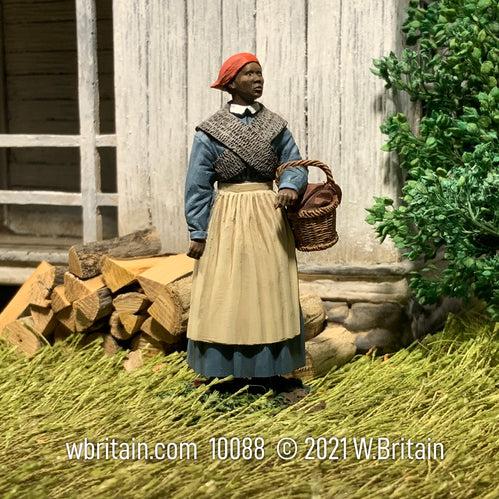
Harriet Tubman American Abolitionist
Harriet Tubman American Abolitionist
Couldn't load pickup availability
On the night of June 1, 1863, three Union gunboats — the John Adams, the Harriet A. Weed, and the Sentinel — pushed up the Combahee River from Beaufort, South Carolina, into Confederate territory. The raid had been planned by Harriet Tubman. Born into slavery in Maryland around 1822, escaped from it in 1849, the conductor on the Underground Railroad who had returned south thirteen times to lead approximately seventy enslaved people to freedom in the North without losing a single passenger, Tubman had been working since 1862 for the Union Department of the South as a nurse, a cook, and — more importantly — as a scout and spy. She had recruited a network of Black informants on the South Carolina coast and had personally reconnoitered the Confederate positions along the Combahee. The raid she planned hit Confederate supply depots and bridges along the river, destroyed rice plantations belonging to wealthy secessionists, and — most consequentially — picked up enslaved people who had been told by Tubman's scouts that the Union gunboats were coming. By dawn on June 2, over seven hundred and fifty enslaved men, women, and children had crowded onto the Union boats and were sailing back to Beaufort and freedom. It was the first armed military raid in American history planned and led by a woman, and it remains the largest single liberation event the Civil War produced. Tubman continued working for the Union Army through 1864, lived in Auburn, New York after the war, became an early women's suffrage advocate, and died in 1913. She was buried with military honors at Fort Hill Cemetery.
The W. Britain figure depicts Tubman in the working civilian dress she wore through most of her adult life — dark blue gathered dress, cream-colored apron, knitted shawl, and the red head wrap that became visually associated with her in nineteenth-century engravings. The wicker basket on her arm is the practical detail — Tubman moved through Maryland, Delaware, Philadelphia, and the Sea Islands of South Carolina in clothing that drew no attention, carrying baskets that could legitimately hold food or laundry or messages. She was small (about five feet tall), unobtrusive, and quietly armed when she needed to be — she carried a pistol on her Underground Railroad trips, in part to discourage frightened passengers from turning back. The figure is catalogued as civilian rather than military, but her Civil War service was as real as any uniformed soldier's; the U.S. government did not officially recognize her military pension until 1899, three decades after the war and fourteen years before her death. Pair this figure with Frederick Douglass, the abolitionist whose anti-slavery work overlapped with hers for nearly half a century; with President Abraham Lincoln, the wartime commander-in-chief whose Emancipation Proclamation gave Tubman's Combahee Raid its political authority; or with Colonel Robert Gould Shaw, whose 54th Massachusetts arrived at Beaufort, South Carolina the same month as Tubman's raid and operated alongside her in the Department of the South.
Scale: 1/30 (60mm). Matte-painted metal. W. Britain model 10088. From the American Civil War range. Single civilian foot figure, supplied painted and ready for display.
Share
Materials
Materials
Metal
Dimensions
Dimensions
54mm
Care information
Care information
These are not play toys. They are collectables. Recommended for 14 yrs old and older.

Although considered toy soldiers, they are pretty amazing in their historical accuracy making them
A collectable item for diorama displays
- 5 stars: 1 (100%)
- 4 stars: 0 (0%)
- 3 stars: 0 (0%)
- 2 stars: 0 (0%)
- 1 star: 0 (0%)
Although considered toy soldiers, they are pretty amazing in their historical accuracy making them
A collectable item for diorama displays

Continue Shopping
See more of the Breagans' collection of manufacturers from all around the world
Subscribe to our emails
Subscribe to our mailing list for insider news, product launches, and more.