

W. Britain
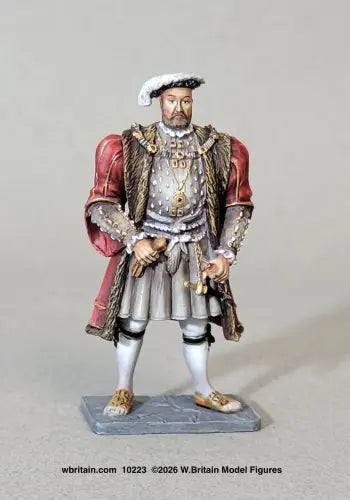
Henry VIII, King of England
Henry VIII, King of England
Couldn't load pickup availability
Everyone can picture Henry VIII, and what they are picturing is a painting that no longer exists. Hans Holbein the Younger painted the Whitehall Mural in 1536–37 — four figures arranged around a marble plinth, Henry with his wife Jane Seymour and his parents Henry VII and Elizabeth of York, most likely made to mark the birth of the heir, Edward, in October 1537. Holbein's decision was to abandon the three-quarter view that royal portraits had always used and turn the king square to the room: legs spread apart, arms held out from the sides in the pose of a warrior or a wrestler, a glove in one hand and the other resting near an ornate dagger. There is no crown in it and no sceptre. The majesty is entirely in the stance, which is the whole trick — and it was a lie in the kindest sense, because the man being painted was in his forties, still recovering from a fall in the tiltyard, and already a good deal less well than the picture admits. Whitehall Palace burned in 1698 and the mural burned with it. What survives is Holbein's full-size cartoon, now in the National Portrait Gallery, and a copy of the whole composition made by Remigius van Leemput in 1667, now at Hampton Court, together with the versions sent abroad as diplomatic gifts, which is how the image travelled. The stance outlived the painting, the palace and the king. Every Henry VIII since has stood in it, down to Charles Laughton's Oscar-winning turn on film — and so, exactly, does this figure.
He is in court dress rather than armour, which is the right choice for the Holbein pose: a crimson gown thrown back off the shoulders and lined with fur, a slashed and jewelled doublet beneath, a heavy gold collar hung with pendants, a flat plumed bonnet, white hose, and the broad square-toed shoes of the 1530s that were the period's own reaction against the long pointed toes of the century before. His hands are where Holbein put them, at the belt and near the dagger. He has natural company in this collection. Joan of Arc belongs to the war he spent much of his reign trying to restart — she broke the English hold on France in the 1420s, and Henry invaded in 1513 in conscious imitation of Henry V, measuring himself against Agincourt as everyone else did. Napoleon on Marengo is the same phenomenon as this figure: a ruler most of us picture through a painter's invention rather than a face, Jacques-Louis David doing for Napoleon what Holbein had done for Henry two and a half centuries earlier. For the battle itself, Tradition of London's Thomas Strickland Esq. with Banner of St George at Agincourt carries the banner Henry's own French campaigns marched under — though at 54mm and in gloss, that one is a link on history rather than a companion for the same display.
Model: 10223 / W. Britain / 1/30 scale / matte finish / 1 piece set
Share
Materials
Materials
Metal
Dimensions
Dimensions
54mm
Care information
Care information
These are not play toys. They are collectables. Recommended for 14 yrs old and older.

Continue Shopping
See more of the Breagans' collection of manufacturers from all around the world
Subscribe to our emails
Subscribe to our mailing list for insider news, product launches, and more.