


King and Country
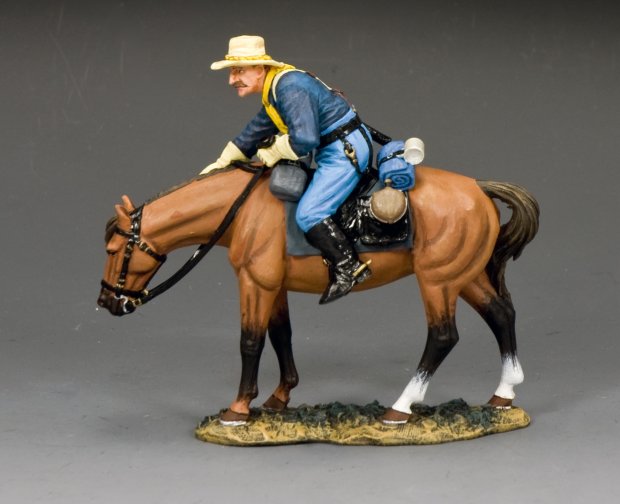
Trooper Leaning Forward (TRW170)
Trooper Leaning Forward (TRW170)
Couldn't load pickup availability
The man on this horse was far likelier to walk away than to die in a battle. Between October 1866 and September 1867 Custer's own regiment recorded 512 desertions — more than twice the number of men who would die with him at the Little Bighorn nine years later. Across the Army the rate ran "as high as 32.6 percent in 1871," and of the 255,712 men who enlisted between 1867 and 1891, "88,475 — practically a third — deserted." Cavalrymen "were more likely to desert than those in other branches of the service." The reasons were not mysterious. Pay had been sixteen dollars a month during and after the Civil War; from 1871 to 1891 it was "thirteen dollars for thirty days' service," and a recruit's first year also had to cover his own clothing, so that by 1889 "a private made sixty-seven cents per day, while a laborer in civilian life made between $1.50 and $2 for the same work." Troops at Montana posts in 1867 went ten months without being paid at all. Most officers who studied the problem "pointed to work as common laborers as the greatest cause of discontent" — the Omaha Herald wrote in 1879 that "the regular soldier on the frontiers is no more nor less than a beast of burden" — and when a hundred inmates were interviewed at Alcatraz in 1872, "the primary cause for their desertion was the want of sufficient food." Private Charles Lester put it more briefly, in April 1867: "I have sixteen months to serve yet and when it is up they can go to the devil; they wont get this chile again." Custer's answer, that July, was to send a pursuit party after thirteen deserters with orders to use lethal force. Three were shot and one of them died. He was court-martialed, convicted, and suspended for a year without pay, and his own verdict on the method was this: "The effect was all that could be desired. There was not another desertion as long as I remained with the command."
All of which makes this quiet figure arguably the truest one in the range. There is no charge here and no last stand — just a man leaning out over a lowered head on what K&C rightly call "a relaxed yet alert posture often seen during long patrols," with the full field kit strapped behind him and the reins loose. That was the job: months of it, for thirteen dollars, and a third of the men who signed up for it decided it was not worth the money. A serving officer, Lieutenant Colonel Alfred Hough, wrote in 1887 that "men assume their uniforms of their own accord, and feel free to leave as they come." Lt. Col. George Armstrong Custer is the officer whose response to all this put him in front of a court. The US Cavalryman, Mounted takes up the other half of the trooper's problem, which was keeping the horse fed. And Trooper Turning in the Saddle is this one's near twin, built to ride beside him.
Model: TRW170 / King & Country / 1/30 (60mm) scale / matte finish / 1 mounted figure
Share
Materials
Materials
Metal
Dimensions
Dimensions
54mm
Care information
Care information
These are not play toys. They are collectables. Recommended for 14 yrs old and older.


Continue Shopping
See more of the Breagans' collection of manufacturers from all around the world
Subscribe to our emails
Subscribe to our mailing list for insider news, product launches, and more.