


W. Britain
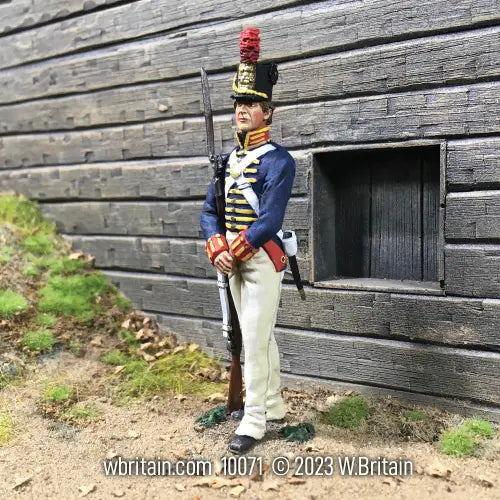
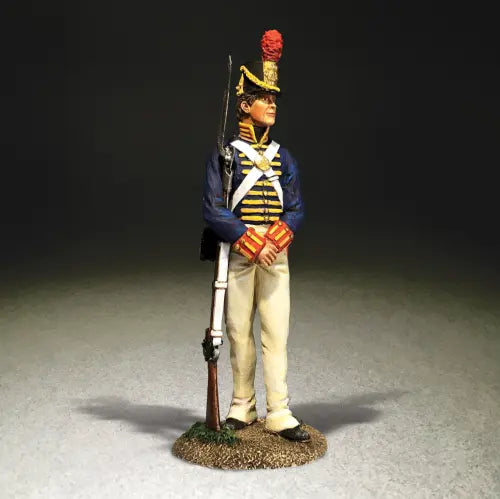
U.S. Artilleryman, 1813-14
U.S. Artilleryman, 1813-14
Couldn't load pickup availability
The guns this man served could throw a ball the better part of a mile and hit almost nothing at that distance. Smoothbore cannon were notoriously inaccurate — a round leaving the muzzle went more or less where the bore pointed and then did as it pleased — so artillery in 1812 was a direct-fire weapon in the literal sense. The crew had to see what they were shooting at, which meant standing where the enemy could see them back. Heavier pieces could reach a thousand yards; the range at which they could be relied upon to do anything was far shorter. That single fact shapes everything about the branch: why guns were fought at the front of a position rather than behind it, why the choice of ground mattered more than the weight of metal, and why gunners took casualties out of all proportion to their numbers. The American service had the common 6-pounder, heavier iron pieces, and captured Canadian 24-pounders. The one action that everyone in the country still knows is an artillery action, though few people think of it that way: at Fort McHenry in September 1814, Captain Frederick Evans and the gunners with him answered a British naval bombardment with over a hundred cannon, including heavy 24-pounders. What Francis Scott Key was describing from the water, and what a stadium full of people sings before ball games, is a night of shellfire and the men working guns through it.
The figure is one of those gunners in the dress of the period — dark blue coatee with yellow worsted lace across the breast, white trousers, and the tall leather shako with its red plume, the branch marking that told everyone at a glance he was not infantry. The musket at his side is not decoration; artillerymen were armed for close defense, because a battery that lost its guns to a rush lost everything. The officer who spent the spring of 1814 drilling the army that fought alongside batteries like this one is General Winfield Scott. His opposite number in the line is the U.S. Infantryman of the same war. And the British garrison troops on the other side of the lakes, who took an American fort of artillerymen without firing more than one round, are the 10th Royal Veteran Battalion.
Model: 10071 / W. Britain / 1/30 scale / matte finish / 1 piece set
Share
Materials
Materials
Metal
Dimensions
Dimensions
54mm
Care information
Care information
These are not play toys. They are collectables. Recommended for 14 yrs old and older.

Continue Shopping
See more of the Breagans' collection of manufacturers from all around the world
Subscribe to our emails
Subscribe to our mailing list for insider news, product launches, and more.