


W. Britain
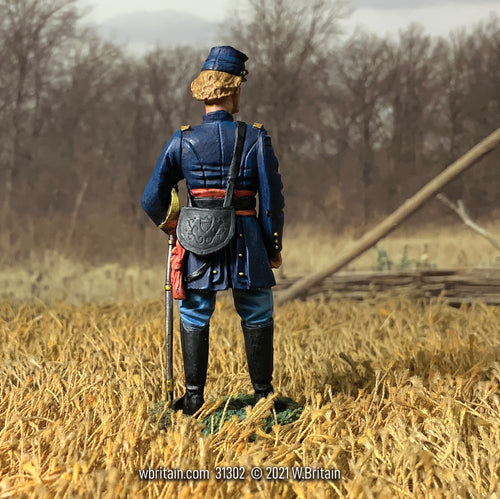
Captain George Armstrong Custer
Captain George Armstrong Custer
Couldn't load pickup availability
George Armstrong Custer graduated from the United States Military Academy at West Point in June 1861 — thirty-fourth and last in his class of thirty-four. The Civil War, four months old, was the only reason he was commissioned at all. Within two years he had transformed himself from West Point's worst graduate into the most aggressive young cavalry officer in the Army of the Potomac. He served as a courier at First Bull Run, as a staff officer under George McClellan through the Peninsula Campaign of 1862, and as captain of the 5th U.S. Cavalry through the Maryland and Pennsylvania campaigns of 1862 and 1863. On the morning of June 29, 1863 — two days before the Battle of Gettysburg began — Custer was a captain. That afternoon Brigadier General Alfred Pleasonton, the new commander of the cavalry corps, jumped him over dozens of senior officers and three intermediate ranks directly to brigadier general of volunteers, assigning him the Michigan Cavalry Brigade. He was twenty-three years old, the youngest general officer in the United States Army. Three days after that, on July 3 at East Cavalry Field east of Gettysburg, his brigade fought J.E.B. Stuart's Confederate cavalry to a standstill and prevented Stuart from reaching the Union rear during Pickett's Charge. This W. Britain figure depicts Custer in the rank he held for the last twenty-four hours of his career as one — the captain who was about to disappear into the legend of the Boy General.
The figure shows Custer in a captain's dark blue cavalry frock coat with the two rows of buttons, light blue cavalry trousers, high black field boots, and the regulation forage cap of the United States Army. The red officer's sash at the waist is the regulation sash for an officer on duty; the saber at his left hip is the Model 1860 light cavalry saber the U.S. mounted forces had adopted three years earlier. The long fair hair under the cap is already a Custer trademark — he had grown it out as a cadet at West Point against regulation and refused to cut it after commissioning. By the time he was a brigadier general the long hair, the red neckerchief, the gold-laced velveteen uniform of his own design, and the red headquarters guidon were all part of a deliberate self-presentation. Captain Custer was already most of the way there. Pair this figure with Maj. Gen. J.E.B. Stuart, the Confederate cavalry commander whose troopers Custer would fight to a standstill at East Cavalry Field three days after this figure's rank expired; with Brig. Gen. John Buford, the senior Union cavalry commander whose Day 1 stand at Gettysburg made the rest of the battle possible; or with Maj. Gen. George B. McClellan, the commanding general whose staff Custer had served on through the Peninsula Campaign of 1862.
Scale: 1/30 (60mm). Matte-painted metal. W. Britain model 31302. From the American Civil War range. Single foot figure, supplied painted and ready for display.
Share
Materials
Materials
Metal
Dimensions
Dimensions
54mm
Care information
Care information
These are not play toys. They are collectables. Recommended for 14 yrs old and older.



Continue Shopping
See more of the Breagans' collection of manufacturers from all around the world
Subscribe to our emails
Subscribe to our mailing list for insider news, product launches, and more.