


W. Britain
General John Buford
General John Buford
Couldn't load pickup availability
What John Buford did at Gettysburg was not just hold ground. He chose it. When his cavalry division arrived at Gettysburg on the afternoon of June 30, 1863, Buford rode the terrain himself and recognized what no other commander had yet articulated: the ridges south of town — Cemetery Hill, Cemetery Ridge, the Round Tops — formed the strongest defensive position any battle in Pennsylvania was likely to offer. Whichever army occupied those ridges first would force the other to attack uphill. Buford had two brigades of cavalry, roughly 2,700 troopers. Heth's Confederate division — three brigades, around 7,600 infantry — was advancing east from Cashtown the next morning. Buford's tactical problem was simple: he had to hold long enough for John Reynolds's I Corps to arrive on the ridges behind him. His tactical solution was to dismount his troopers along McPherson's Ridge west of town and use the Sharps breech-loading carbine — which a kneeling man could load and fire three times in the time it took an infantryman to load a muzzle-loading rifle once — to make 2,700 men shoot like a much larger force. They held for nearly three hours. Reynolds's I Corps arrived around ten in the morning and took the line. Reynolds was dead within the hour. The Iron Brigade went into McPherson's Woods. Buford's troopers, exhausted but still in line, moved south to screen the flanks. By that evening Meade's army was concentrating on the ground Buford had chosen the day before. Buford himself was dead within six months — typhoid fever, December 16, 1863, age thirty-seven. Lincoln promoted him to Major General on his deathbed.
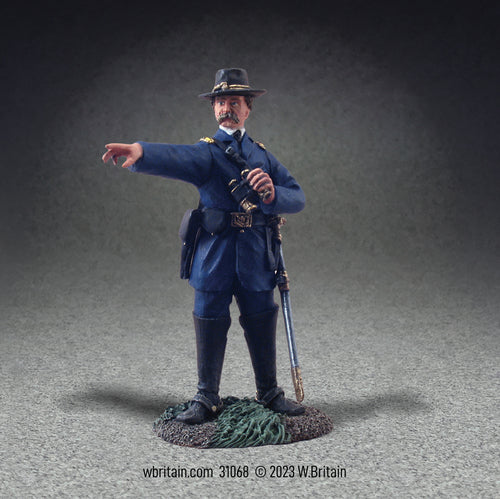
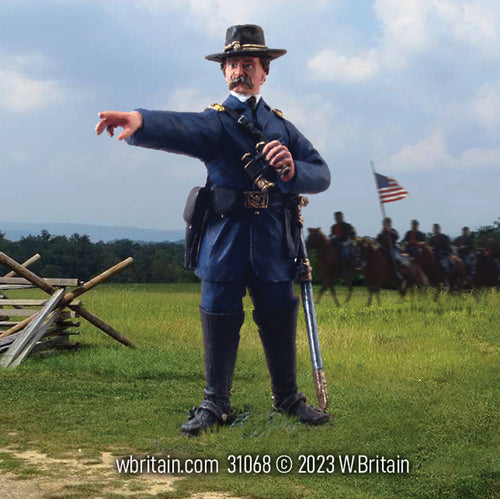
The W. Britain figure depicts Buford in the moment that produced his most famous image: dismounted, right arm extended, calmly pointing out the Confederate approach to his staff and battery commanders. He wears the dark blue cavalry officer's frock coat with two rows of buttons, the buff sash of a general officer at his waist, the black slouch hat with the gold staff cord, and the high cavalry boots that pulled up over the knee. The cavalry saber hangs at his left hip — a weapon Buford by all accounts disliked using on horseback, preferring carbines and revolvers. He was a Kentuckian by birth, a regular army officer by training (West Point class of 1848), and a cavalryman by temperament — quiet, observant, blunt with subordinates, contemptuous of political appointees. Pair this figure with Maj. Gen. George G. Meade, the army commander who arrived at the ground Buford had picked and chose to fight on it; with Lt. Gen. A.P. Hill, the Confederate III Corps commander whose lead division (Heth) Buford fought on the morning of July 1; or with Col. Henry A. Morrow of the 24th Michigan, whose Iron Brigade regiment relieved Buford's troopers on McPherson's Ridge and held the line through the rest of the morning's fighting.
Scale: 1/30 (60mm). Matte-painted metal. W. Britain model 31068. From the American Civil War range. Single foot figure, supplied painted and ready for display.
Share
Materials
Materials
Metal
Dimensions
Dimensions
54mm
Care information
Care information
These are not play toys. They are collectables. Recommended for 14 yrs old and older.
Great likeness and detail
Thank you for your positive review of General John Buford product. We are glad to hear that you are happy with your purchase. Thank you for choosing Breagans for your Toy Soldiers!
Regards,
Daniel
- 5 stars: 1 (100%)
- 4 stars: 0 (0%)
- 3 stars: 0 (0%)
- 2 stars: 0 (0%)
- 1 star: 0 (0%)
Great likeness and detail
Thank you for your positive review of General John Buford product. We are glad to hear that you are happy with your purchase. Thank you for choosing Breagans for your Toy Soldiers!
Regards,
Daniel

Continue Shopping
See more of the Breagans' collection of manufacturers from all around the world
Subscribe to our emails
Subscribe to our mailing list for insider news, product launches, and more.