


W. Britain
General George Meade
General George Meade
Couldn't load pickup availability
George Meade was promoted to command the Army of the Potomac on the morning of June 28, 1863 — three days before the Battle of Gettysburg began. He had not asked for the command. Lincoln had relieved Joseph Hooker because Hooker was demanding more troops and threatening to resign while Robert E. Lee's Army of Northern Virginia was already across the Potomac and somewhere in Pennsylvania. On June 27 Meade was a V Corps commander; on the morning of June 28 he was at the head of an army of 90,000 men. He had three days to grasp the army's full dispositions, locate Lee, and pick where to fight before the two armies collided. He picked the ridges south of Gettysburg town — Cemetery Hill, Culp's Hill, the long stone wall of Cemetery Ridge, and the Round Tops — and fought a three-day defensive battle. Lee broke himself attacking it. On July 3 the climactic Confederate assault, Pickett's Charge, crossed three-quarters of a mile of open ground into massed Union artillery and rifle fire and failed at the stone wall. Lee retreated to Virginia and never again invaded the North. Lincoln, hoping Meade would press Lee into total defeat before he reached the Potomac, was famously disappointed when Meade let him escape; the President drafted a sharp letter and then chose not to send it. The Battle of Gettysburg remains the costliest engagement ever fought on North American soil — roughly 51,000 casualties across both armies in three days.
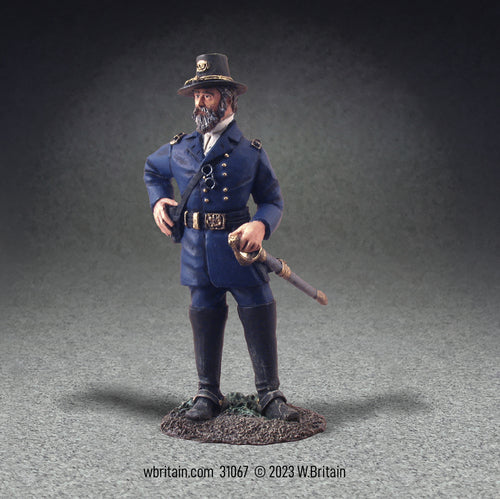
This W. Britain figure depicts Meade in the dark blue major general's frock coat, the black slouch hat with the gold staff officer's cord, the wide buff sash that distinguished a general officer at a glance, and the high black cavalry boots field officers preferred over the formal regulation kit. The drawn sword in his right hand catches him in the moment a commander raised on engineering and defensive principle — Meade had supervised lighthouse construction on the Florida coast and the Washington defenses before the war — became the active director of a battlefield in motion. He was not a charismatic commander in the way Hancock or Custer were; staff officers described him as quick-tempered, blunt, and irritable under pressure but fundamentally competent and willing to listen to subordinates who knew the ground. Pair this figure with General Robert E. Lee for the Gettysburg bilateral — the only time the two men commanded against each other; with Maj. Gen. Winfield Scott Hancock, the II Corps commander who arrived first at Cemetery Hill on July 1 to take charge of the Union position and who held the center of the line that broke Pickett's Charge on July 3; or with Brig. Gen. John Buford, the cavalry commander who dismounted his troopers west of town on the morning of July 1 and bought the time Meade needed for the infantry to arrive on the high ground.
Scale: 1/30 (60mm). Matte-painted metal. W. Britain model 31067. From the American Civil War range. Single foot figure, supplied painted and ready for display.
Share
Materials
Materials
Metal
Dimensions
Dimensions
54mm
Care information
Care information
These are not play toys. They are collectables. Recommended for 14 yrs old and older.
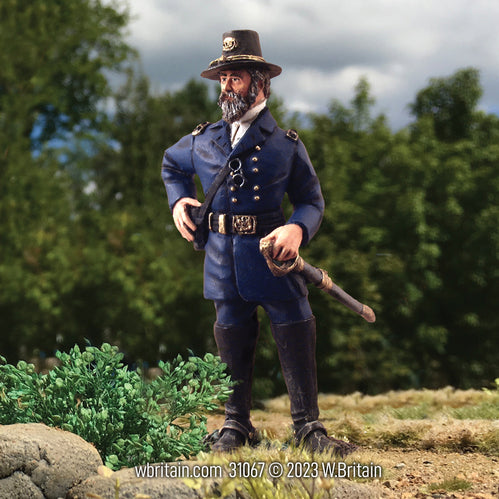
Very realistic and finally a union general that’s not holding binoculars
- 5 stars: 1 (100%)
- 4 stars: 0 (0%)
- 3 stars: 0 (0%)
- 2 stars: 0 (0%)
- 1 star: 0 (0%)
Very realistic and finally a union general that’s not holding binoculars

Continue Shopping
See more of the Breagans' collection of manufacturers from all around the world
Subscribe to our emails
Subscribe to our mailing list for insider news, product launches, and more.