


W. Britain
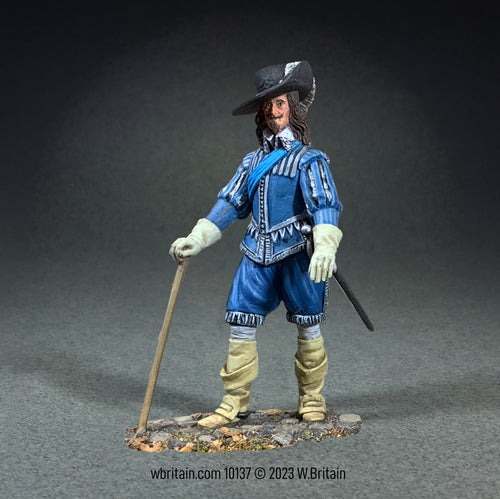
English King Charles I, 1649
English King Charles I, 1649
Couldn't load pickup availability
The High Court of Justice sat from 20 to 27 January 1649, and Charles never entered a plea. He asked instead, again and again, by what authority the court claimed to try him — and no one gave him an answer that held, because there was not one to give. No law in England provided for the trial of a king; the court had been brought into existence for this single purpose. He went further, and this is the part that makes the whole business difficult: he argued that in refusing to recognise the court he was defending the liberty of the subject, since if a king could be tried by a body that had simply appointed itself, then no one in the kingdom had security under law at all. On that narrow point he was right, and the men trying him knew it. The answer his opponents had, and it is not a weak one, was that a king who claimed to stand above the law had already removed every other remedy — you cannot be sued, deposed or bound by a Parliament you insist derives its authority from you. Two propositions, both sound, meeting at a place where only one of them could survive. He lost every argument of his reign except the last one, and the last one he won.
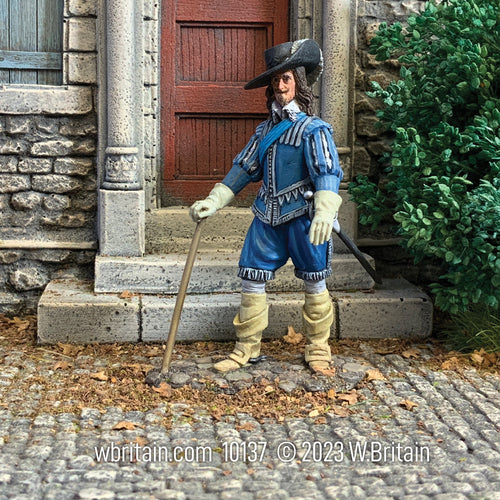
He was beheaded on 30 January 1649, outside the Banqueting House at Whitehall. He had asked for a second shirt that morning, saying he would not have the crowd mistake shivering from cold for cowardice, and he went out dressed in black with his blue Garter sash — which is the sash on this figure, worn here over the slashed blue doublet, full breeches and bucket-top boots of a court dress of the 1640s, hat plumed, cane in hand, gloves in the other. To Bishop Juxon on the scaffold he said he went from a corruptible crown to an incorruptible one. Guards had pushed the crowd back too far to hear him, so the speech survives only because a man beside him took it down in shorthand. The royalist Philip Henry wrote afterwards of "such a groan as I never heard before" going up from the crowd at the blow — worth knowing that no other contemporary account mentions it. On the other side of the argument stands Oliver Cromwell, who thought further negotiation with him was pointless. The claim Charles was defending had been built two reigns earlier by Henry VIII, who made the Crown supreme over the English church and left his successors a throne that answered to nobody. And the cause did not die with him: a century later men were still fighting for the Stuarts, as Highland Clansman, the Jacobite Rebellion of 1745 shows.
Model: 10137 / W. Britain / 1/30 scale / matte finish / 1 piece set
Share
Materials
Materials
Metal
Dimensions
Dimensions
54mm
Care information
Care information
These are not play toys. They are collectables. Recommended for 14 yrs old and older.

Continue Shopping
See more of the Breagans' collection of manufacturers from all around the world
Subscribe to our emails
Subscribe to our mailing list for insider news, product launches, and more.