


W. Britain
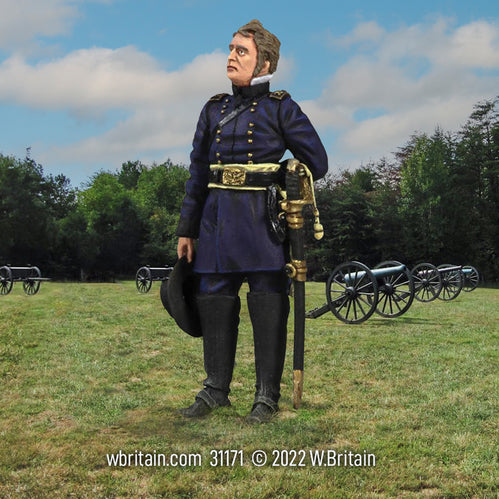
General Joseph "Fighting Joe" Hooker
General Joseph "Fighting Joe" Hooker
Couldn't load pickup availability
When Lincoln appointed Joseph Hooker to command the Army of the Potomac on January 26, 1863, the army had lost three commanders in two years — McClellan, Burnside, and Burnside again after Fredericksburg — and morale had collapsed. Lincoln knew Hooker had been talking openly about the country needing a dictator, and wrote him a famously blunt letter alongside the appointment: "Only those generals who gain successes can set up dictators. What I now ask of you is military success, and I will risk the dictatorship." Hooker took the letter and went to work. Through the winter of 1863 he reorganized the army brilliantly — improved rations, restored furloughs, gave each division a distinctive corps badge, consolidated the scattered cavalry into a unified corps that could finally challenge J.E.B. Stuart, and rebuilt the soldiers' confidence. By April the army was 130,000 strong and ready. His plan for the spring campaign was the best operational design any Union general had brought against Robert E. Lee: divide his own army, pin Lee in place at Fredericksburg, march the rest twenty miles upstream and across the Rapidan and Rappahannock, and come down on Lee's left and rear. By the morning of May 1, 1863, he had 70,000 men around Lee's flank at Chancellorsville. Then he stopped. That gave Lee twenty-four hours to act, and what Lee decided was to divide his outnumbered army and send Stonewall Jackson on a fourteen-mile flank march around Hooker's own right. On the evening of May 2, Jackson's 28,000 men struck the XI Corps from the west and rolled it up in three hours. On May 3 a Confederate cannonball hit a wooden column at Hooker's headquarters at the Chancellor house; the impact threw Hooker against the porch and concussed him. He kept command but his judgment was gone. Within four days the Army of the Potomac was back across the Rappahannock. Lincoln relieved Hooker eight weeks later — three days before Gettysburg — and replaced him with George Meade.
The W. Britain figure depicts Hooker in the dark blue major general's frock coat with the two rows of buttons, the wide buff sash, the Model 1850 staff and field officer's sword scabbarded at his left hip, the light blue cavalry-pattern trousers, and the black field boots. His right hand holds the forage cap down at his side — a portrait stance rather than a battlefield one, fitting a commander whose reputation rests more on what he did with the Army of the Potomac than on his physical presence on a battlefield. The reddish-blond hair and the lighter beard distinguish him from photographs of the dark-haired bearded generals he served alongside. He earned the nickname "Fighting Joe" by accident — a New York newspaper printed a dispatch headline reading "Fighting — Joe Hooker is advancing" with the dash dropped, and the result stuck. Hooker himself reportedly hated the nickname. Pair this figure with Lt. Gen. Thomas "Stonewall" Jackson, the corps commander whose fourteen-mile flank march on May 2, 1863 destroyed Hooker's Chancellorsville plan; with General Robert E. Lee, the overall Confederate commander whose decision to divide his own outnumbered army against Hooker's flanking column is generally considered the most audacious operational gamble of the war; or with Maj. Gen. George G. Meade, the V Corps commander Lincoln promoted in Hooker's place three days before Gettysburg.
Scale: 1/30 (60mm). Matte-painted metal. W. Britain model 31171. From the American Civil War range. Single foot figure, supplied painted and ready for display.
Share
Materials
Materials
Metal
Dimensions
Dimensions
54mm
Care information
Care information
These are not play toys. They are collectables. Recommended for 14 yrs old and older.


Continue Shopping
See more of the Breagans' collection of manufacturers from all around the world
Subscribe to our emails
Subscribe to our mailing list for insider news, product launches, and more.