


W. Britain
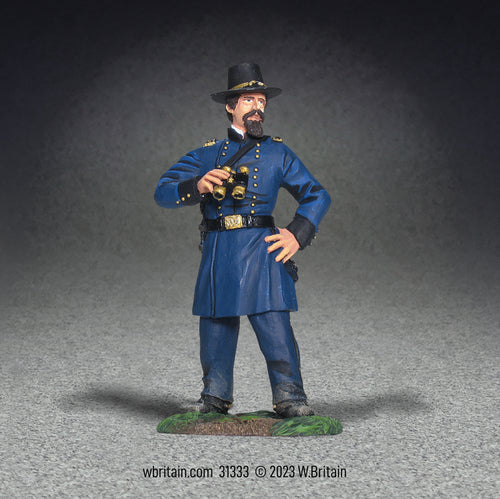
General Winfield Scott Hancock
General Winfield Scott Hancock
Couldn't load pickup availability
On the afternoon of July 1, 1863, with John Reynolds dead and the Union I and XI Corps falling back through Gettysburg, Meade — thirteen miles away at Taneytown and without firsthand knowledge of the ground — made the most consequential delegation of his life. He sent Winfield Scott Hancock forward with discretionary authority to take command of all Union forces on the field and decide a single question: was Gettysburg defensible, or should the Army of the Potomac fall back to a prepared position at Pipe Creek? Hancock arrived on Cemetery Hill in the late afternoon, surveyed the ground east and south of town — the high cemetery ridge, Culp's Hill anchoring the right, the Round Tops anchoring the left — and made the decision. He sent word back to Meade: come to Gettysburg, this is the ground. Meade did. The army concentrated overnight on the ridges Hancock had endorsed. The battle that followed was fought on the position Hancock had picked the previous afternoon. Two days later he was wounded in the center of his own line — a bullet through the saddle pommel into his right thigh during Pickett's Charge — and refused to leave the field until the assault was broken. The thigh wound never properly healed. Hancock fought for another year under Grant in the Overland Campaign, was the Democratic nominee for President in 1880 (losing to James Garfield by roughly 7,000 popular votes nationwide), and died in 1886, his health never fully restored after the Gettysburg wound.
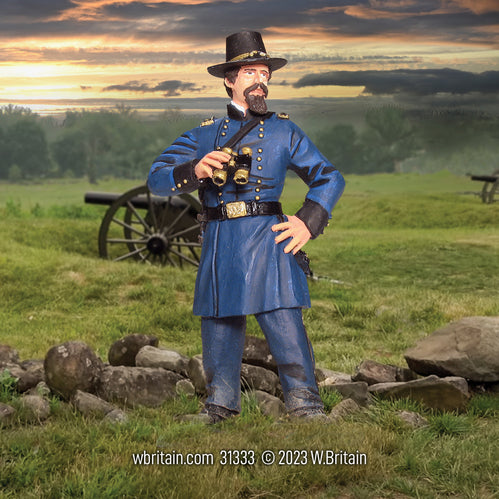
The W. Britain figure depicts Hancock in the moment that defined him visually: field glasses held to his chest, surveying the position from the high ground. He wears the dark blue major general's frock coat with the two rows of staff buttons, the wide buff sash of a general officer, the regulation belt with the cast brass officer's buckle, and the black slouch hat preferred over the formal forage cap by every senior Union commander after 1862. He was a regular army officer — West Point class of 1844, two years ahead of McClellan and Jackson at the Academy — and was called 'Hancock the Superb' by McClellan after the Battle of Williamsburg in 1862and "the Thunderbolt of the Army of the Potomac" by his own men later. Staff officers said the nicknames were earned not by dramatic gestures but by the calm and clarity with which Hancock moved corps-sized formations under fire. Pair this figure with Maj. Gen. George G. Meade, who delegated the choice of ground to Hancock when his own ability to make it was thirteen miles away; with Brig. Gen. John Buford, whose cavalry held the morning of July 1 long enough for Hancock to arrive and confirm the position; or with Maj. Gen. George Pickett, whose division crossed three-quarters of a mile of open ground on July 3 to break against the center of the line Hancock was holding.
Scale: 1/30 (60mm). Matte-painted metal. W. Britain model 31333. From the American Civil War range. Single foot figure, supplied painted and ready for display.
Share
Materials
Materials
Metal
Dimensions
Dimensions
54mm
Care information
Care information
These are not play toys. They are collectables. Recommended for 14 yrs old and older.

Continue Shopping
See more of the Breagans' collection of manufacturers from all around the world
Subscribe to our emails
Subscribe to our mailing list for insider news, product launches, and more.