


W. Britain
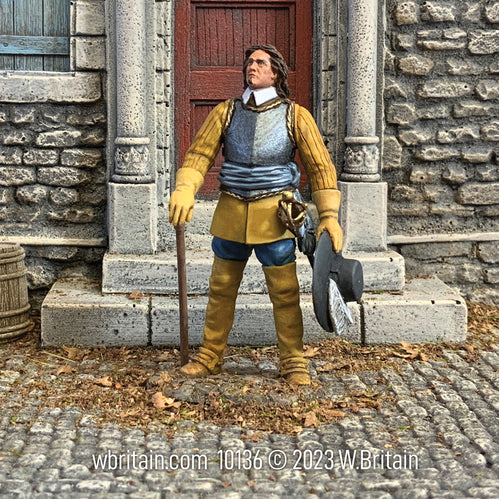
Oliver Cromwell, 1649
Oliver Cromwell, 1649
Couldn't load pickup availability
In October 1644, in the middle of a bitter argument with the Earl of Manchester about how the army ought to be run, Cromwell wrote the sentence that explains everything he did afterwards: "I would rather have a plain russet-coated captain who knows what he fights for and loves what he knows than that which you call a gentleman and is nothing else." It is easy to miss how radical that was. In the seventeenth century a command was a form of property — inherited, purchased, or owed to a man because of who his father had been — and Cromwell was proposing to hand it instead to whoever could do the job. The following April the New Model Army was established under Thomas Fairfax with Cromwell as lieutenant-general of horse, and the principle went in with it: loyal, capable, well-behaved men, regardless of their religion or their social standing. The Self-Denying Ordinance of the same year forced members of Parliament to choose between a seat and a commission, and every one of them complied except Cromwell, whose command was extended again and again because nobody could afford to lose him. The royalist armies were built out of the social order they were fighting to preserve. The New Model was built out of whether a man was any good. That, more than any single battle, is why it won.
The figure is Cromwell in the field dress of that army — buff coat, breast and back plate over it, sash, tall boots, broad-brimmed hat with a plume held in one hand and a cane in the other. The year on the box is the hardest in his life to summarise. In January the king was tried and executed; from August, Cromwell was in Ireland, where the storming of Drogheda in September left around 3,500 dead, including civilians and priests, and Wexford in October perhaps 2,000 soldiers and as many as 1,500 civilians. He called Drogheda a righteous judgment of God. Historians still divide sharply over it — some read it as ordinary seventeenth-century siege law, in which a garrison that refused terms forfeited quarter; others as something well beyond that — and the argument has never been settled. Eight years later Parliament offered him the crown, and after six weeks of agonising he refused it on 13 April 1657: "I would not seek to set up that which Providence hath destroyed and laid in the dust." He was reinstalled as Lord Protector instead, wearing royal regalia, in Westminster Hall. The man he replaced is Charles I; the cause that outlived them both is on Highland Clansman, the Jacobite Rebellion of 1745, still trying to put a Stuart back on the throne a century later; and the institution he declined to join is still there in King Charles III.
Model: 10136 / W. Britain / 1/30 scale / matte finish / 1 piece set
Share
Materials
Materials
Metal
Dimensions
Dimensions
54mm
Care information
Care information
These are not play toys. They are collectables. Recommended for 14 yrs old and older.


Continue Shopping
See more of the Breagans' collection of manufacturers from all around the world
Subscribe to our emails
Subscribe to our mailing list for insider news, product launches, and more.