


W. Britain
Royal Canadian Mounted Police
Royal Canadian Mounted Police
Couldn't load pickup availability
The march that founded the legend was very nearly a catastrophe. Canada had bought Rupert's Land in 1870 and had no way of governing it; whisky traders were running north out of American posts like Fort Whoop-Up, about thirty Assiniboine had been killed in the Cypress Hills in June 1873, and Ottawa was uneasy about what the United States Army might decide to do about the disorder if nobody else did. So John A. Macdonald raised a mounted police force for what he called the preservation of peace and the prevention of crime. On 8 July 1874 two hundred and seventy-five of them left Fort Dufferin and rode nearly nine hundred miles west. The planning had been done by men who had never seen the country. Horses died of cold and hunger, the provisions ran out, and the survivors came in barefoot and in rags. They never got to Fort Whoop-Up at all; they built Fort Macleod instead and called it a success. The historian William Baker's verdict is worth quoting whole — "a monumental fiasco of poor planning, ignorance, incompetence, and cruelty to men and beasts" — and he adds that it was later romanticised as an epic of endurance. Both halves are true. The organisation was a disgrace and the endurance was real, and the men who did the walking were not the men who did the planning. One decision from that first summer was sound, and this figure is wearing it: the coats were made scarlet deliberately, to look like British and Canadian soldiers rather than American cavalry, so that the nations of the plains would know at a glance whose authority had arrived.
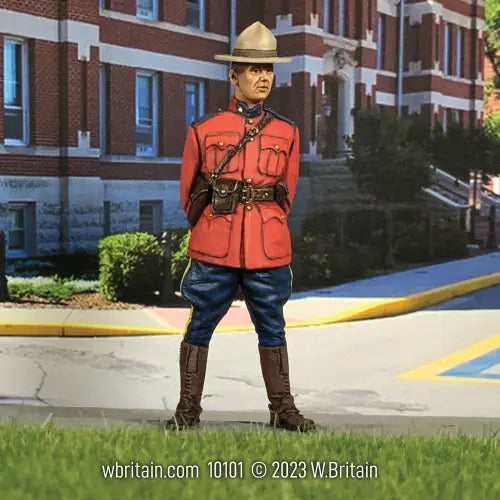
The figure stands in the modern version of that uniform — red serge, Stetson, blue breeches with the yellow stripe, brown boots, belt and pouches. The force grew from 150 recruits in 1873 to 300 the following year and 500 by 1882, and it turned out to be better at the work than at the march. In 1877, after the Little Bighorn sent them north, roughly 5,600 Lakota under Sitting Bull crossed into Canadian territory; Assistant Commissioner Acheson Irvine negotiated with them, two hundred police were posted to Fort Walsh, supplies were shared, and the long process of return was managed without a battle — Sitting Bull finally surrendered in 1881. The man whose defeat set that in motion is George Armstrong Custer. Edward VII made the force Royal in 1904 for its Boer War service, and in 1920 it merged with the Dominion Police to become the RCMP. Its ceremonial arm rides on the mounted trooper, and the female trooper completes the set.
Model: 10101 / W. Britain / 1/30 scale / matte finish / 1 piece set
Share
Materials
Materials
Metal
Dimensions
Dimensions
54mm
Care information
Care information
These are not play toys. They are collectables. Recommended for 14 yrs old and older.


Continue Shopping
See more of the Breagans' collection of manufacturers from all around the world
Subscribe to our emails
Subscribe to our mailing list for insider news, product launches, and more.