


Tradition of London
The Signing of the Armistice
The Signing of the Armistice
Couldn't load pickup availability
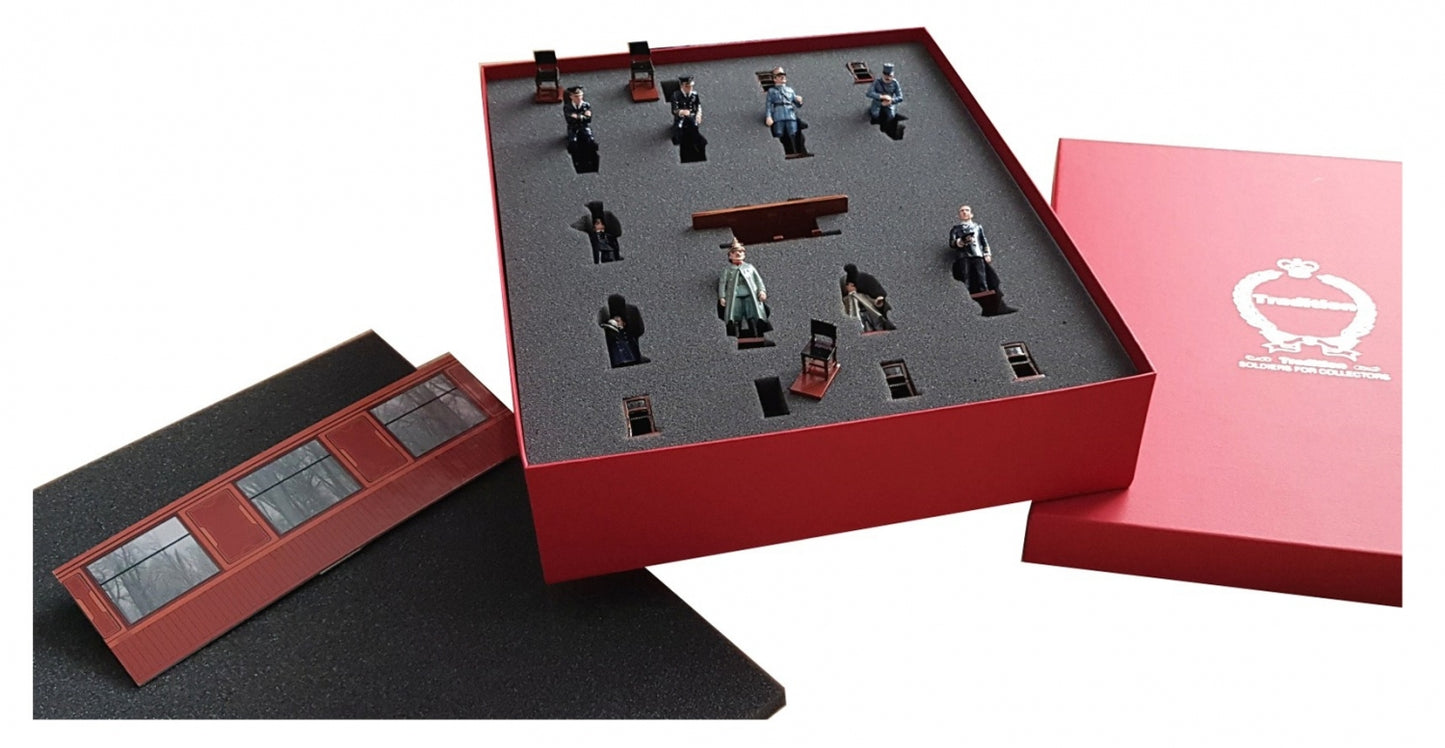
The carriage in this set was built in May 1914, three months before the war it would end. Wagons-Lits 2419D was a dining car. On 11 November 1918 Erzberger's delegation signed the armistice inside it, in a clearing near Compiègne, and France afterwards kept it as a monument. On 21 June 1940 Hitler had it hauled out of its museum and set down on the exact spot it had stood in 1918, and made France surrender in it the following day. It was taken to Berlin and put on display. On 21 April 1945, with the Allies closing in, retreating SS troops destroyed it rather than let it be captured.
Tradition has built the room: the carriage, the table, the chairs, the papers, the little flags, and the nine men who were in it, each sculpted as himself. Erzberger is the civilian in the overcoat — which is the point of him, a politician sent to sign what the generals would not. Weygand read the terms aloud; Foch came in only at the start and for the signing itself. In a diorama it is the far end of the outbreak of the war, and the only set in this range that ends something rather than starts it. Foch has his own figure here. Kaiser Wilhelm II had abdicated two days earlier and was not invited.
Tradition of London model 826. 54mm, white metal, hand-painted in gloss enamel. Multi-piece set — nine figures with the Wagons-Lits carriage, table and chairs, 11 November 1918. Supplied in the Tradition Classic Red Box. Allow 2–3 weeks delivery.
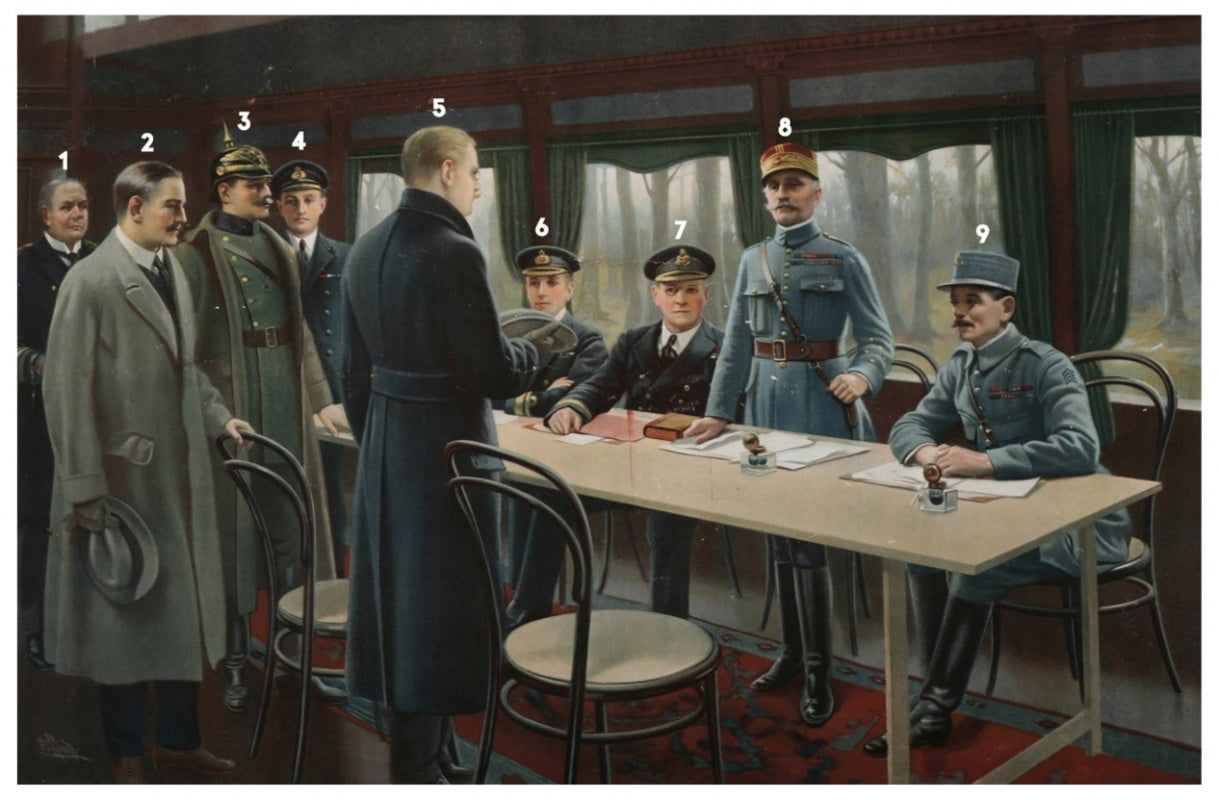
1). Captain Ernst Vanselow - Imperial German Navy
(The likely reason for Vanselow’s selection for the delegation was his expertise as a legal scholar, who collaborated with the Swiss university lecturer, Eduard Otto von Waldkirch on the ‘Handbook of International Law’, published by G.A. Waltz).
2). Count Alfred Graf von Oberndorff - German Foreign Ministry
(Oberndorff held a Doctorate in Law, and had been in the diplomatic service since 1900 as both embassy secretary and ambassor).
3). Major General Sigismund Detlof von Winterfeldt – Imperial German Army
(Military representative to the German Chancellor in Berlin since 1917. He would later resign in protest at the harsh treaty conditions being imposed, and retired from the army in 1919).
4). Captain Jack P. R. Marriott – Royal Navy
(Then an Acting Captain – Only confirmed as full Captain the following month. Marriott had been Naval Assistant to the First Sea Lord, Rosslyn Wemyss, since 1915).
5). Matthias Erzberger – German Secretary of State without portfolio
(Head of the German Delegation, Erzberger had been a prominent campaigner for a negotiated peace since 1917. He was assassinated in 1921 by German right wing ultra-nationalists who regarded him as a traitor).
6). Rear Admiral Sir George P. W. Hope – Royal Navy
(At one time the commander of the dreadnought HMS Queen Elizabeth, Hope was appointed Deputy First Sea Lord in 1918, and promoted to Vice-Admiral in 1920.)
7). Vice Admiral Sir Ross Wemyss – Royal Navy
(Then the First Sea Lord, and the British signatory of the armistice. Promoted full Admiral in February 1919, then Admiral of the Fleet in November 1919, has was also raised to the peerage as Baron Wester Wemyss).
8). Marshal Ferdinand J. M. Foch – French Army
(Marshal of France & Commander-in-Chief of Allied Forces, and the French signatory to the armistice. Dissatisfied with what he saw as the lenient terms of the Treaty of Versailles that followed, Foch prophetically declared: ‘This is not a peace. It is an armistice for twenty years’.)
9). General Maxime Weygand – French Army
(Foch’s Chief-of-Staff. It was Weygand who read out the terms of the armistice to the German delegation – Foch was present only briefly at the start of negotiations and for the actual signing. In 1940, in his role as Supreme Commander of French Forces, it would be Weygand who demanded that an armistice be sought with Germany).
It is an interesting footnote in history that the original ‘Eleventh Hour’, when the Armistice was to take effect, was set as 11am, Paris time.
It was actually high noon for Germany. But despite the respective time differences, it is still the eleventh hour that is used to mark the two-minute silence on Remembrance Day in most nations of the British Commonwealth.
After four years of commemorative sets, ‘The Signing of the Armistice’ is Tradition’s fitting tribute to those who fell in the ‘The War to End all Wars’,
Text by Paul Cattermole, with thanks ToL
Thank you to RP World Models, Bob Prati who gave us the idea and made it possibel to bring this Toy set out
Share
Materials
Materials
Cast in quality white metal, hand painted gloss enamels.
Dimensions
Dimensions
54mm
Care information
Care information
These are not play toys. They are collectables. Recommended for 14 yrs old and older.


Continue Shopping
See more of the Breagans' collection of manufacturers from all around the world
Subscribe to our emails
Subscribe to our mailing list for insider news, product launches, and more.