

W. Britain
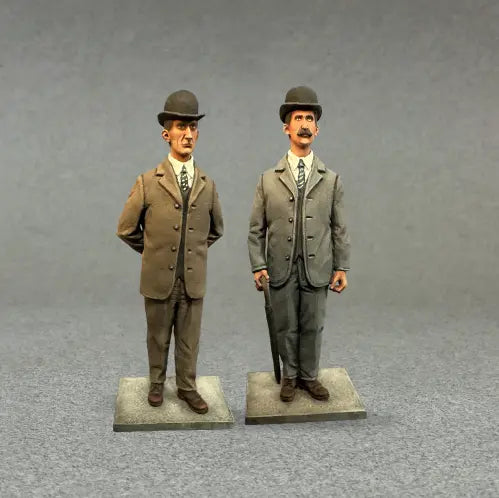
The Wright Brothers, Orville and Wilbur Wright, 1903
The Wright Brothers, Orville and Wilbur Wright, 1903
Couldn't load pickup availability
What the Wrights invented was not lift. Plenty of people had got a wing to carry weight, and an engine light enough to bolt onto one was a matter of waiting for the engine. What nobody had solved was how to steer. The brothers ran a bicycle shop from December 1892 — the Wright Cycle Exchange, later the Wright Cycle Company — and the trade gave them the insight everyone else missed: their work with bicycles convinced them that an unstable machine could be controlled and balanced with practice, the way a rider does it without thinking. Their competitors were trying to build an aircraft that would fly itself. The Wrights set out to build one a person could ride. What came out of that was three independent controls on three axes — wing-warping for roll, elevator for pitch, rudder for yaw — and when they patented it in 1906, U.S. Patent 821,393 covered a system of aerodynamic control rather than a flying machine as such. They were rigorous about the rest of it too. In 1901, having found Lilienthal's published lift figures unreliable, they built a six-foot wind tunnel and spent October to December testing 200 model wings of different shapes and curves, then went back and tested thirty-eight of them in detail, writing their own data tables because the existing ones were wrong. On 17 December 1903 the machine flew four times. Wilbur had won the coin toss but stalled his attempt on the 14th, so Orville went first: twelve seconds and a hundred and twenty feet. Then about a hundred and seventy-five, then two hundred, and finally fifty-nine seconds and eight hundred and fifty-two feet. John T. Daniels took the photograph. Five people watched — three men from the lifesaving station, a local businessman and a boy.
The set is two civilians in suits and bowler hats, one with his hands clasped behind his back and the other resting on an umbrella, exactly as they presented themselves in photographs: not adventurers, not showmen, two engineers from Ohio who had done the arithmetic. Everything downstream of them is in this collection too. Fifteen years later the machine they controlled had become a weapon, flown by men like Eddie Rickenbacker and Manfred von Richthofen. Thirty-nine years later, Jimmy Doolittle flew a bomber off an aircraft carrier — a distance that would have been unimaginable to five people standing on a beach in North Carolina in 1903.
Model: 10138 / W. Britain / 1/30 scale / matte finish / 2 figures
Share
Materials
Materials
Metal
Dimensions
Dimensions
54mm
Care information
Care information
These are not play toys. They are collectables. Recommended for 14 yrs old and older.

Continue Shopping
See more of the Breagans' collection of manufacturers from all around the world
Subscribe to our emails
Subscribe to our mailing list for insider news, product launches, and more.