


W. Britain
"Vali" Viking War Cry
"Vali" Viking War Cry
Couldn't load pickup availability
A war cry is a technique, and the earliest description of the Germanic version comes from a man whose army stood in front of it. Writing around AD 98, Tacitus recorded verses "by the recital of which, termed 'barding,' they stimulate their courage; while the sound itself serves as an augury of the event of the impending combat" — they listened to their own noise and read their chances in it. The tone was chosen, not merely loud: "a harsh, piercing note, and a broken roar, are the favorite tones; which they render more full and sonorous by applying their mouths to their shields." It was, he wrote, "not so much an articulate song, as the wild chorus of valor." Three centuries later Ammianus Marcellinus described the same practice among Germanic troops in Roman service, beginning "with a faint hum, gradually intensifying, like the roaring of the ocean waves crashing against cliffs," and the Roman writer Vegetius advised that the cry be raised only as the lines closed, since an early one is wasted. That is a long way from a Viking beach — the barritus belongs to the continental Germans of the first to fourth centuries, and nobody troubled to write down what a ninth-century ship's crew actually shouted. But it is the nearest thing we have to testimony from someone who heard it, and it says exactly what this open mouth says: the noise was aimed, it was timed, and it was part of the weapon.
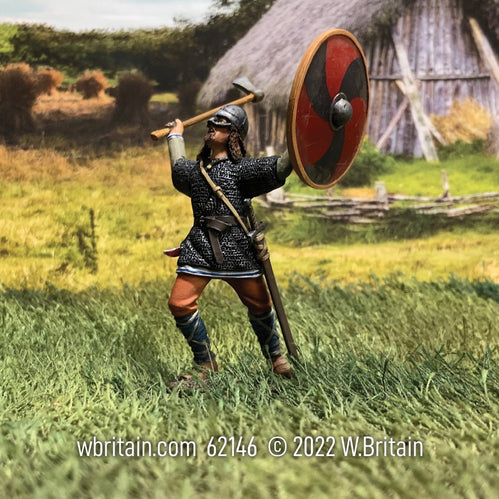
W. Britain name him for Váli, the son of Odin who in the Norse poems avenges the death of Baldr, but the man on the base is mortal and kitted like one — a mail shirt, a nasal helmet, long braided hair, a spear held upright, an axe swung back overhead, and a red and cream round shield lifted beside his face, which is not far from where Tacitus's warriors put theirs. The shield itself, and how those boards were actually built, is the subject of "Halvar" Viking Defending with Sword and Shield; the helmet and the horned-helmet myth belong to the other Viking axeman, "Fritjof" Viking Attacking with Axe. Put him at the front of a war band with "Alfgeir" Viking Throwing Spear behind him and the shafts already going over, and set the whole group opposite "Seaver" Saxon Shield Wall Defender — a diorama of the few seconds before contact, which is precisely the moment Vegetius said the shout was for.
Model: 62146 / W. Britain / 1/30 scale / matte finish / 1 piece set
Share
Materials
Materials
Metal
Dimensions
Dimensions
54mm
Care information
Care information
These are not play toys. They are collectables. Recommended for 14 yrs old and older.


Continue Shopping
See more of the Breagans' collection of manufacturers from all around the world
Subscribe to our emails
Subscribe to our mailing list for insider news, product launches, and more.