

W. Britain
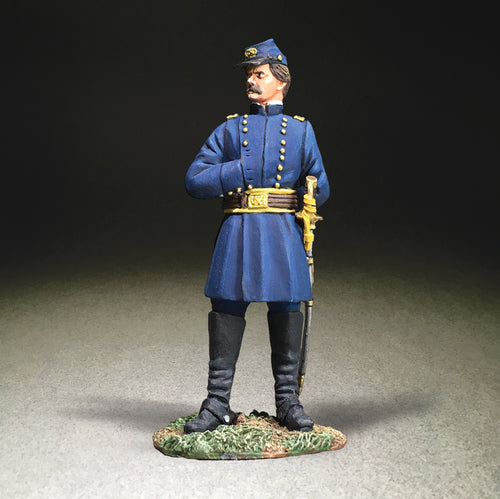
General George McClellan
General George McClellan
Couldn't load pickup availability
In 1861, after the Union defeat at First Bull Run made it obvious the war would not be over by Christmas, Lincoln gave Major General George B. McClellan command of what would become the Army of the Potomac. Through the autumn and winter of 1861–62, McClellan did something no American commander had attempted at this scale: he built a professional army from civilian volunteers. He drilled, organized, supplied, and disciplined more than 120,000 men into a force capable of standing in line of battle against Robert E. Lee. His men loved him for it. They called him "Little Mac." He called himself, in letters home, by less modest comparisons — McClellan had read deeply in military history at West Point and saw his own ascent in Napoleonic terms. The hand-inside-the-coat pose his photographs captured, and that this W. Britain figure reproduces, was a deliberate Napoleonic borrowing. What McClellan could not do was use the army he had built. He consistently overestimated Confederate strength, demanded reinforcements that were not available, and recoiled from committing his reserves at the moment they would have been decisive. At Antietam on September 17, 1862 — the bloodiest single day in American history — he outnumbered Lee nearly two to one and had a copy of Lee's secret operational orders in his hand, yet attacked piecemeal in three uncoordinated assaults, kept his fresh reserves uncommitted, and let Lee escape across the Potomac the next day. The battle was a strategic Union victory because it gave Lincoln the political cover to issue the Emancipation Proclamation five days later. McClellan was relieved from field command seven weeks after Antietam and never received another. He ran against Lincoln for the presidency in 1864 and lost.
This W. Britain figure depicts McClellan in the dark blue major general's frock coat with the two rows of buttons, the buff sash, the regulation belt with the cast officer's buckle, the Model 1850 staff and field officer's sword at his hip, and the forage cap with cavalry insignia — McClellan had served in the 1st U.S. Cavalry before the war and designed the McClellan saddle, adopted by the U.S. cavalry in 1859 and used until the cavalry was mechanized in 1934. The hand-inside-the-coat pose between the buttons of the frock coat is the Napoleon-portrait gesture, taken from Jacques-Louis David's full-length state portraits of the Emperor and recognized as Napoleonic by any reasonably educated American of the 1860s. The pose was not accidental. McClellan posed this way for the camera throughout 1862. He believed it. Pair this figure with General Robert E. Lee, the opposite number McClellan outnumbered at Antietam and let escape across the Potomac; with President Abraham Lincoln, the political superior McClellan repeatedly snubbed in office and then ran against for President in 1864; or with Captain George Armstrong Custer, who served on McClellan's staff through the Peninsula Campaign of 1862 and would later lead the Michigan Cavalry Brigade in the Shenandoah Valley during the 1864 campaign that Lincoln's reelection — over McClellan — made possible.
Scale: 1/30 (60mm). Matte-painted metal. W. Britain model 31299. From the American Civil War range. Single foot figure, supplied painted and ready for display.
Share
Materials
Materials
Metal
Dimensions
Dimensions
54mm
Care information
Care information
These are not play toys. They are collectables. Recommended for 14 yrs old and older.

Continue Shopping
See more of the Breagans' collection of manufacturers from all around the world
Subscribe to our emails
Subscribe to our mailing list for insider news, product launches, and more.