

King and Country
Running Buffalo (TRW047)
Running Buffalo (TRW047)
Couldn't load pickup availability
Running Buffalo is not a historical person. No chronicle or census records him, and as with Bloody Lance the name belongs to the figure rather than to a man. The animal, though, is the center of the entire war. Somewhere between thirty and sixty million buffalo were on the plains in the middle of the nineteenth century; by the end of it there were about three hundred left in the wild. Whether that was policy is one of the real arguments in Western history, and it turns on an absence. Robert Utley has written that there "was never any such policy," and Robert Wooster that the army "did not make the virtual extermination of the American bison part of its official policy." In the narrow sense both are right: no written order has ever been found. What exists instead is what the officers said. Sherman to Sheridan, May 1868 — "Until the Buffalo and consequent[ly] Indians are out [from between] the Roads we will have collisions and trouble." Sheridan to Sherman that October — "The best way for the government is to now make them poor by the destruction of their stock." Lieutenant Colonel Luther Bradley's journal that winter — "Ordered to the forks of the Republican to make permanent camp: to kill all the buffalo we find." Lieutenant Colonel Richard Dodge in 1867 — "Kill every buffalo you can! Every buffalo dead is an Indian gone." Nelson Miles in 1874 — "I would leave as few Indians or Buffalo behind, and as little for them to subsist on as possible." And a hide hunter named Mayer, describing what the army posts handed out: "free ammunition, all you could use, all you wanted, more than you needed." David Smits, whose essay assembles all of this, argues that the silence in the files is itself the evidence — that Sheridan "deliberately refused to issue the relevant written orders," knowing an order given aloud "could be more easily concealed or more plausibly denied." Not everyone in uniform went along: Colonel William Hazen wrote in January 1872 that "the theory that the buffalo should be killed to deprive the Indians of food is a fallacy," and Lieutenant Colonel Albert Brackett of the 2nd Cavalry called the slaughter "as needless as it is cruel." Seven weeks after recommending the destruction of their stock, Sheridan wrote that "there are more buffalo than will last the Indians for 20 years."
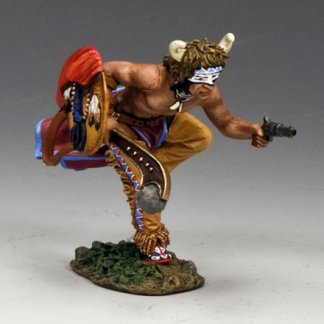
The figure holds both halves of that story at once: a man wearing buffalo horns and carrying a revolver, charging with a shield slung at his back, his leggings beaded in blue and white and his face painted. K&C call the pistol a captured army revolver, which is a nice idea and not a checkable one for a man who never existed, but a Colt in the hand of a Plains fighter in the 1870s needs no excuse. Bloody Lance is the collection's other archetype and the obvious companion. Sitting Bull took his people to Canada and came back to surrender in 1881 because they were hungry. And Little Wolf's page is what life looked like once the herds had gone and a nation's food arrived — or failed to — by requisition.
Model: TRW047 / King & Country / 1/30 (60mm) scale / matte finish / 1 foot figure
Retired by King & Country in October 2026. Limited stock remaining.
Share
Materials
Materials
Metal
Dimensions
Dimensions
54mm
Care information
Care information
These are not play toys. They are collectables. Recommended for 14 yrs old and older.

Continue Shopping
See more of the Breagans' collection of manufacturers from all around the world
Subscribe to our emails
Subscribe to our mailing list for insider news, product launches, and more.