


W. Britain
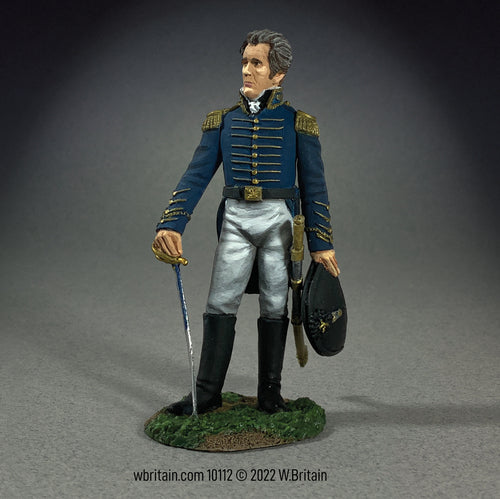
U.S. General Andrew Jackson, 1813-14
U.S. General Andrew Jackson, 1813-14
Couldn't load pickup availability
The Creek War is usually described as America against the Creeks. It was not. It was a war inside the Muscogee nation, between the Red Sticks who opposed American expansion and the Lower Creek and National Council who had accommodated it — and when Jackson marched to the Tallapoosa in the spring of 1814, roughly six hundred Cherokee, Choctaw and Lower Creek warriors marched with him. On March 27, 1814, about a thousand Red Sticks held Tohopeka, a village in the horseshoe bend of the river, behind a log-and-dirt breastwork four hundred yards long thrown across the neck of the peninsula. Jackson had some 2,700 men, the 39th U.S. Infantry and Tennessee militia among them. General John Coffee took mounted infantry and the allied warriors across the river to close the back door, and the position became a trap; Coffee's men shot down two hundred warriors trying to swim clear. Around eight hundred of the thousand Red Sticks were killed. Jackson lost fewer than fifty dead and a hundred and fifty-four wounded. What followed is the part worth knowing. By the Treaty of Fort Jackson, signed on August 9, 1814, the Creek Nation ceded twenty-three million acres — and the cession took in land belonging to the Lower Creek who had fought on his side, along with 1.9 million acres claimed by the Cherokee, who had also fought on his side. The treaty drew no distinction between the nations that had fought against him and the nations that had fought for him.
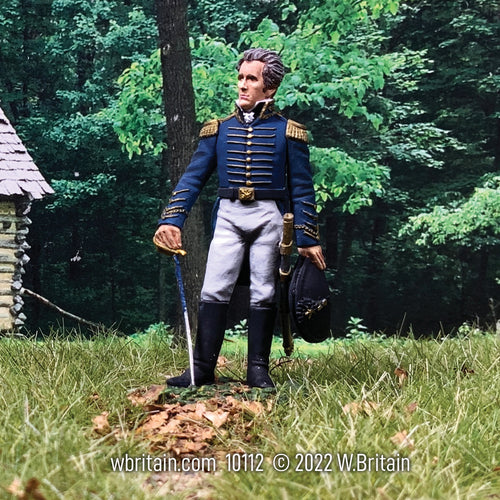
This is Jackson at forty-seven, in the blue and gold of a major general of that campaign — braided facings, heavy epaulettes, white breeches and tall boots, bicorne under one arm and the sword out in his other hand. He was still a Tennessee militia general when the Creek War began and a national figure by the time it ended, and the following January at New Orleans he became something more than that. Riding as a scout with the Tennessee volunteers on this same campaign was a young man named David Crockett, who would be famous for something else entirely two decades later. In the north, William Henry Harrison was fighting the other half of the same war and would follow Jackson to the presidency by the same route, a battle and a nickname. Winfield Scott makes the useful contrast — the professional soldier of that war, who spent fifty years in uniform and never got the White House at all.
Model: 10112 / W. Britain / 1/30 scale / matte finish / 1 piece set
Share
Materials
Materials
Metal
Dimensions
Dimensions
54mm
Care information
Care information
These are not play toys. They are collectables. Recommended for 14 yrs old and older.

Continue Shopping
See more of the Breagans' collection of manufacturers from all around the world
Subscribe to our emails
Subscribe to our mailing list for insider news, product launches, and more.